














By Fiona Burlig, Amir Jina and Anant Sudarshan
Context
Over two billion people globally lack access to safe drinking water, leading to enormous health consequences: two billion cases of diarrhea and half a million deaths among children under 5 annually. Nevertheless, the aspirational gold standard of piped, potable water access is rarely present in developing countries, with only 14 percent of rural households in low- and middle-income countries enjoying tap water in their homes. Even when pipes do exist, water flowing through the tap is often just as contaminated as local ground- and surface-water sources. Treating water with chlorine tablets can be a solution. But, prior research has shown that even when tablets are given away for free, only around half of households actually want them. This may be because they are inconvenient and leave an unpleasant aftertaste.
While research and policy efforts have been directed towards piped water and this type of “point-of-use” chlorine treatment, two solutions at opposite ends of the cost spectrum, the market for privately-treated and home-delivered water is growing rapidly in developing countries.
Research Design
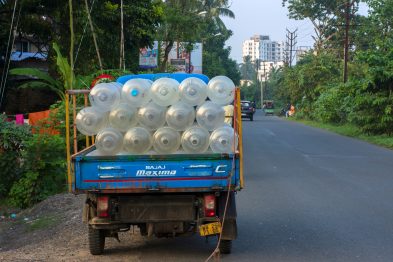
The authors conduct a randomized controlled trial in Odisha, India, covering 60,000 households in 120 villages. They partnered with Spring Health India, a small firm in Odisha whose innovative product involves localized treatment of groundwater (via solar power) coupled with home delivery in large, reusable, sealed containers. The researchers randomly separated households into four groups: some paid for the bottled water at varying discounts, some received a set amount of free bottled water each month, some could choose free water or a cash rebate (or a mix of both), and some (the control group) could choose to purchase water at the high price that it was at prior to the experiment. They evaluate both the demand for drinking water, as well as how that demand changes with the price of the water.
Findings
The demand for clean water is high at low prices, but falls off quickly as costs rise
At very low prices, 89 to 90 percent of households ordered water, demonstrating that this method of delivering clean water could achieve near-complete coverage. Households purchased enough water to cover their entire drinking needs, even when they had access to chlorine and piped water. The study also found that demand falls quickly as prices rise, but even at high prices, those households that continued to buy clean water did so in large enough quantities to cover their drinking needs. This seems consistent with a population that understands that clean water is most useful from a health point of view if it is consumed nearly all of the time.
Clean water improves health and saves time
To understand why households buy the clean water, the researchers surveyed households several times, tracking each household for approximately a six-month period. They found that access to delivered clean water substantially improved health: households who drank clean water reported 23 to 62 percent less illness and fewer missed workdays than those who did not. Clean water also reduced the time household members—often women—spent collecting water each day. These gains mirror prior work on the health impacts of safe water delivered in other ways but are notable for their magnitude and consistency.
Households value clean water more than expected
The study finds that the average willingness to pay for clean water is about $20 per year—or, INR 132 per month for around 300 liters of water (comparable to the monthly spend on milk, INR 186). This averages to roughly 1.5 percent of household expenditures. This willingness to pay for clean water itself is much higher than what other studies have found when trying to estimate the valuation of clean water from purchases of chlorine tablets and water filters, and is more than 4.5 times larger than estimates from rural Kenya inferred based on travel costs to chlorine-treated springs.
Additionally, the study found that when given the choice between ordering water or receiving a cash rebate, households chose to order the clean water. This meant routinely giving up $4.73 per month (INR 420)—4.7 percent of household expenditures (2.5 times the monthly expenditure on milk). Households who ordered water appeared to order enough to meet their drinking needs, and then received the remainder from the rebate, suggesting limited waste.
The study also evaluates how cost effective the policy is, finding the cost per life year is $71-226—substantially below standard global health cost-effectiveness thresholds. Providing chlorine, in comparison, cost $33-106 per life year. While similar in cost effectiveness, the take-up of providing the clean water is 89-90 percent versus 26-36 percent for the chlorine, suggesting that while both approaches are highly cost-effective, clean water delivery may yield greater overall benefits.
Closing Take-Away
The study provides some of the first estimates of how much rural households in low-income settings value environmental quality—measured not through how much chlorine they use or how much time they spend finding clean water, but more directly by letting them choose how much to pay for clean water, or conversely how much money to give up in order to obtain it.
The authors suggest that, since clean water is highly cost-effective, governments should consider spending tax dollars to provide it. The private market alone cannot fully address the clean water access problem; while water delivery can be privately profitable at high prices, relatively few households can afford it without subsidies, even though it delivers substantial benefits. However, a willingness to forgo cash for water—as the study found—may suggest that reducing cash transfers to pay for water would align with public preferences.